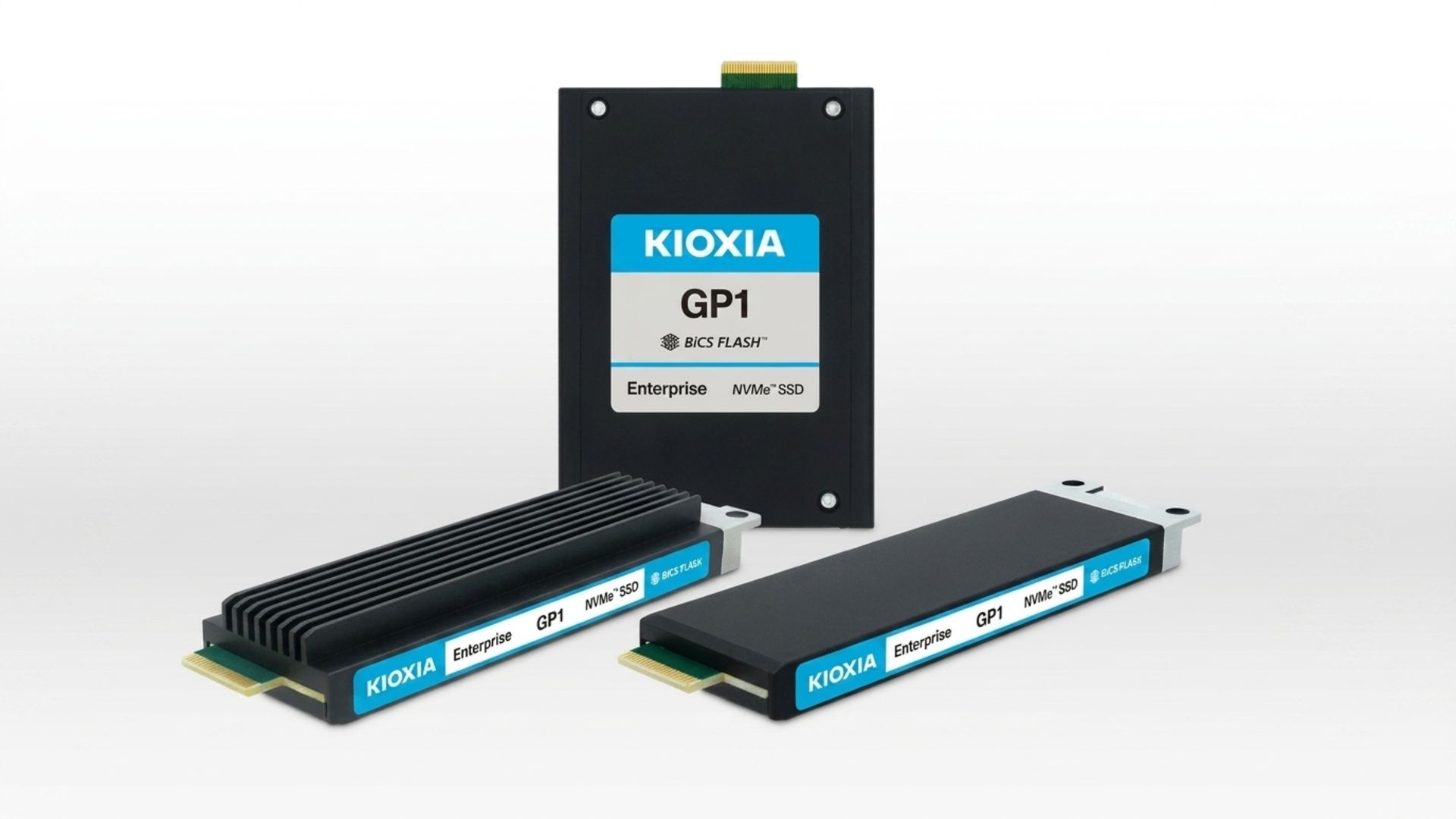
Kioxia beats its own world record with the fastest SSD ever produced — new PCIe 6.0 GP1 tops 20M IOPS and is part of Kioxia's plan to challenge DRAM in AI markets
Kioxia's upgraded GP drive exceeds 20 million random-read IOPS Third-gen XL-FLASH improves memory access through shorter wiring and additional planes Kioxia LD4 launches with 15.36 TB and 30.72 TB capacities Kioxia has announced a faster edition of its GP series drive that exceeds 20 million IOPS wh
<![CDATA[ <article> <ul><li><strong>Kioxia's upgraded GP drive exceeds 20 million random-read IOPS</strong></li><li><strong>Third-gen XL-FLASH improves memory access through shorter wiring and additional planes</strong></li><li><strong>Kioxia LD4 launches with 15.36 TB and 30.72 TB capacities</strong></li></ul><p>Kioxia has announced a faster edition of its GP series drive that exceeds 20 million IOPS when reading 512-byte data blocks at random.</p><p>The GP1 unveiled in August 2026 <a href="https://www.techradar.com/pro/kioxia-showcases-the-worlds-fastest-ssd-with-mind-blowing-10m-iops-and-a-staggering-50-dwpd-endurance">delivered about 10 million IOPS</a>, so the new version roughly doubles the speed of the earlier model.</p><p>The faster model relies on third-generation XL-FLASH memory, which delivers three times the reading speed and roughly 150% higher writing speed than before.</p><h2 id="how-flash-is-meant-to-rival-dram">How flash is meant to rival DRAM</h2><p>The company is pursuing a plan to take on <a href="https://www.techradar.com/pro/kioxia-has-nothing-to-lose-so-it-wants-to-swap-expensive-ddr-for-the-worlds-fastest-ssd-ever-built-to-save-the-world-from-ai-ram-pocalypse" target="_blank">DRAM in AI markets by offering flash storage</a><strong> </strong>that approaches memory-class speed.</p><p>“Kioxia is making game-changing high-performance flash storage solutions for AI infrastructure,” said Neville Ichhaporia, SVP and GM of the SD business unit at Kioxia America.</p><p>“As AI drives new performance demands, scalable, efficient storage becomes the foundation for innovation.”</p><p>Its XL-FLASH technology is designed to deliver higher operation rates, finer 512-byte access and lower power per operation than conventional <a href="https://www.techradar.com/news/best-solid-state-drives-ssds">SSDs</a>.</p><p>The third-generation XL-FLASH shortens its word and bit wiring to cut RC delay and fits more planes in each die than the 16 of Gen 2.</p><p>Its efficiency is forecast to rise roughly 40% for reads, and 80% for writes, yet energy used by each operation is expected to keep climbing.</p><p>The first-generation GP1 uses MLC cells storing 2 bits, a faster SLC mode, a 16-plane layout, and read latency below 5 microseconds.</p><p>It is a PCIe 6.0 NVMe 2.2 drive meant for <a href="https://www.techradar.com/news/computing-components/graphics-cards/best-graphics-cards-1291458">GPUs</a> to reach storage directly, with endurance rated at up to 50 DWPD.</p><p>Kioxia has not disclosed the upgraded model's endurance rating or confirmed whether it keeps the PCIe 6.0 interface, but it will most likely follow the path of its predecessor.</p><h2 id="ld4-arrives-without-performance-figures">LD4 arrives without performance figures</h2><p>Kioxia also exhibited the LD4, a QLC drive with one port that stores 4 bits per cell in E1.L format using a four-lane PCIe 5 link.</p><p>It comes in 15.36 TB and 30.72 TB capacities, though its design can scale to 122.88 TB for hyperscalers, which is still modest compared to the Kioxia LC9’s 246 TB capacity.</p><p>The 15.36 TB model fills a quarter of the E1.L enclosure, with a 61.44 TB version likely at the three-quarter point.</p><p>The LD4 uses 218-layer BiCS 8 flash and appears to succeed the October 2023 LD2, which ran on PCIe 3 with identical capacities.</p><p>It also supports NVMe 2.0, OCP specification 2.6, and full-path safeguards against data loss.</p><p>Kioxia skipped an LD3, so the LD4 follows the LD2 after roughly three years and swaps in a faster PCIe 5 bus.</p><p>Rival E1.L drives with a PCIe 5 interface include the 6550 ION from Micron, the R6060 from DapuStor and the Echo from FADU.</p><p>As of the time of writing, the company has not released the speed or durability figures for the LD4.</p><p>Via <a href="https://www.blocksandfiles.com/flash/2026/10/08/kioxia-doubles-super-fast-flash-drive-speed/5301892" target="_blank" rel="nofollow">Blocksandfiles</a></p><figure class="van-image-figure inline-layout" data-bordeaux-image-check ><div class='image-full-width-wrapper'><div class='image-widthsetter' style="max-width:676px;"><p class="vanilla-image-block" style="padding-top:31.51%;"><img id="diM9tpwF2Lz85R8q85CT78" name="tr-g_news" alt="Google logo on a black background next to text reading 'Click to follow TechRadar'" src="https://cdn.mos.cms.futurecdn.net/diM9tpwF2Lz85R8q85CT78-1920-80.jpg" mos="" align="middle" fullscreen="" width="676" height="213" attribution="" endorsement="" class="inline"></p></div></div></figure> </article> ]]>
Read the full article on TechRadar
Read Full Article →