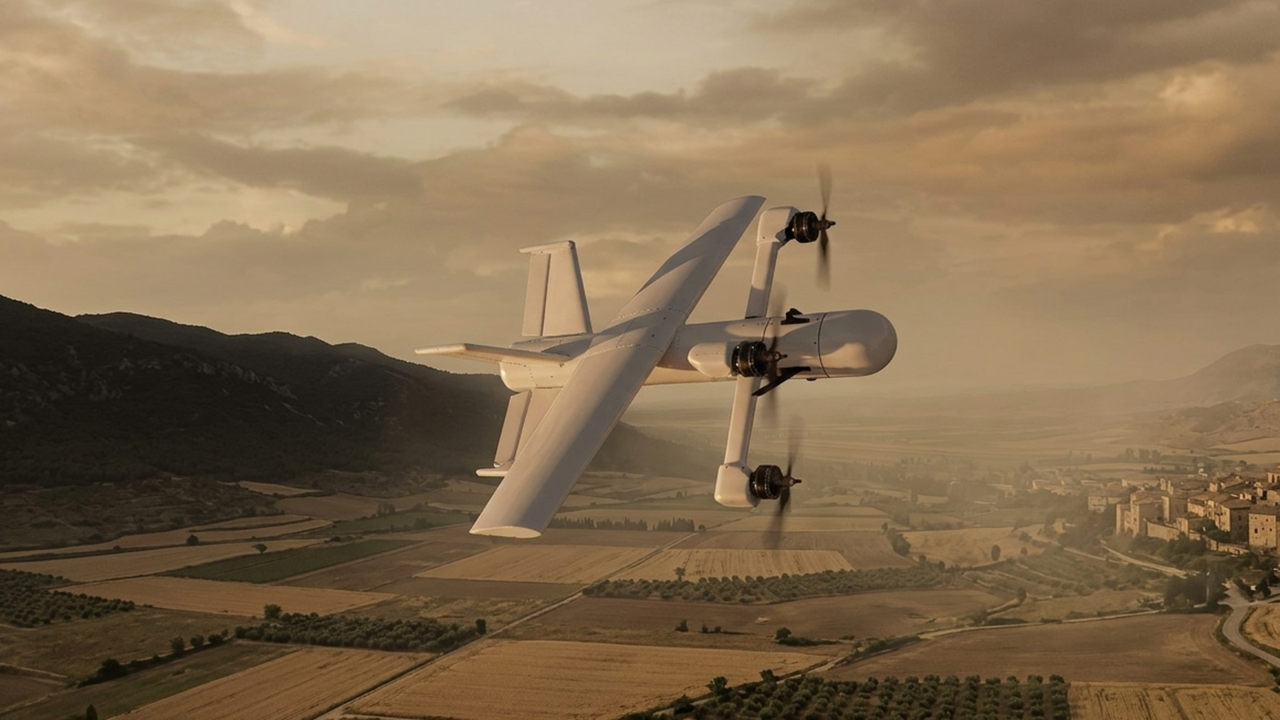
A reusable microwave drone reportedly disables more than 50 hostile UAVs per flight Lockheed Martin pushes cheaper answers to increasingly dangerous battlefield drone swarms The Morfius X-Rotor counter-drone system enters testing after successful multi-state flight evaluations Lockheed Martin has un
<![CDATA[ <article> <ul><li><strong>A reusable microwave drone reportedly disables more than 50 hostile UAVs per flight</strong></li><li><strong>Lockheed Martin pushes cheaper answers to increasingly dangerous battlefield drone swarms</strong></li><li><strong>The Morfius X-Rotor counter-drone system enters testing after successful multi-state flight evaluations</strong></li></ul><p>Lockheed Martin has unveiled its Morfius X-Rotor counter-drone system at the 2026 Farnborough Airshow, calling it a low-cost answer to challenging drone swarms.</p><p>The ground-launched system uses a one-to-many high-power microwave, or HPM, approach designed to disable multiple unmanned aerial vehicles during a single mission.</p><p>Company officials say the platform can neutralize more than 50 hostile <a href="https://www.techradar.com/cameras/drones/best-drone">drones</a> in one flight, a capability aimed at addressing large-scale swarm attacks.</p><h2 id="a-reusable-alternative-to-costly-interceptors">A reusable alternative to costly interceptors</h2><p>The 2026 Farnborough Airshow has centered largely on affordable counter-drone technology as militaries confront growing swarm threats across the globe.</p><p>Lockheed Martin says the approach avoids reliance on costly guided munitions typically used to strike individual aerial threats one at a time.</p><p>Unlike traditional interceptors that are destroyed after use, the Morfius X-Rotor is designed to be recovered and redeployed following each engagement.</p><p>According to Lockheed Martin, the system is compatible with existing command and control networks and does not require a dedicated sensor or fire-control radar.</p><p>That design choice, the company says, lowers the barrier for integration across a wide range of existing battlefield command networks.</p><p>The system “sets a new benchmark for counter-drone capability — delivering a high kill rate while keeping the cost per kill low,” said Randy Crites, vice president and general manager of Lockheed Martin Missiles and Fire Control Advanced Programs.</p><p>“By leveraging a lightweight, field reusable high-power microwave architecture, we provide the most effective, low-cost solution on the market today.”</p><p>Lockheed Martin also announced plans to accelerate prototype production of both the drone platform and its microwave payload for frontline forces.</p><p>However, it has not disclosed a firm timeline for when the system might reach full-rate production for its military customers worldwide.</p><h2 id="testing-continues-amid-interceptor-shortages">Testing continues amid interceptor shortages</h2><p>The Morfius X-Rotor recently completed flight testing in Arizona, California, and Oklahoma, where the system reportedly carried out interception missions.</p><p>Additional evaluation campaigns are scheduled for the coming months while engineers collect operational performance data before any broader deployment.</p><p>Lockheed Martin has not specified which branches of the U.S. military have expressed formal interest in acquiring the Morfius platform.</p><p>This announcement arrives as US forces seek cheaper alternatives to costly interceptors after depleting stockpiles against Iranian missiles and Shahed drones.</p><p>That shortfall has intensified debate over whether cheaper, non-kinetic systems like Morfius could reduce dependence on expensive munitions over time.</p><p>Lockheed Martin used the same event to introduce a lower-cost Patriot interceptor, part of a broader push to reduce per-unit defense costs.</p><p>Together, the two announcements suggest Lockheed Martin is betting heavily on affordability as a selling point amid tightening defense budgets.</p><p>Whether the Morfius X-Rotor can match its stated kill rate under real combat conditions remains unverified outside company-run trials so far.</p><p>Independent assessments of its effectiveness against dense, coordinated drone swarms will likely determine whether militaries adopt the system at scale.</p><p>Via <a href="https://www.defensenews.com/industry/techwatch/2026/07/20/lockheed-martins-morfius-x-rotor-built-to-fry-50-enemy-drones-in-one-flight/" target="_blank" rel="nofollow">Defense News</a></p><figure class="van-image-figure inline-layout" data-bordeaux-image-check ><div class='image-full-width-wrapper'><div class='image-widthsetter' style="max-width:676px;"><p class="vanilla-image-block" style="padding-top:31.51%;"><img id="diM9tpwF2Lz85R8q85CT78" name="tr-g_news" alt="Google logo on a black background next to text reading 'Click to follow TechRadar'" src="https://cdn.mos.cms.futurecdn.net/diM9tpwF2Lz85R8q85CT78.jpg" mos="" align="middle" fullscreen="" width="676" height="213" attribution="" endorsement="" class="inline"></p></div></div></figure> </article> ]]>